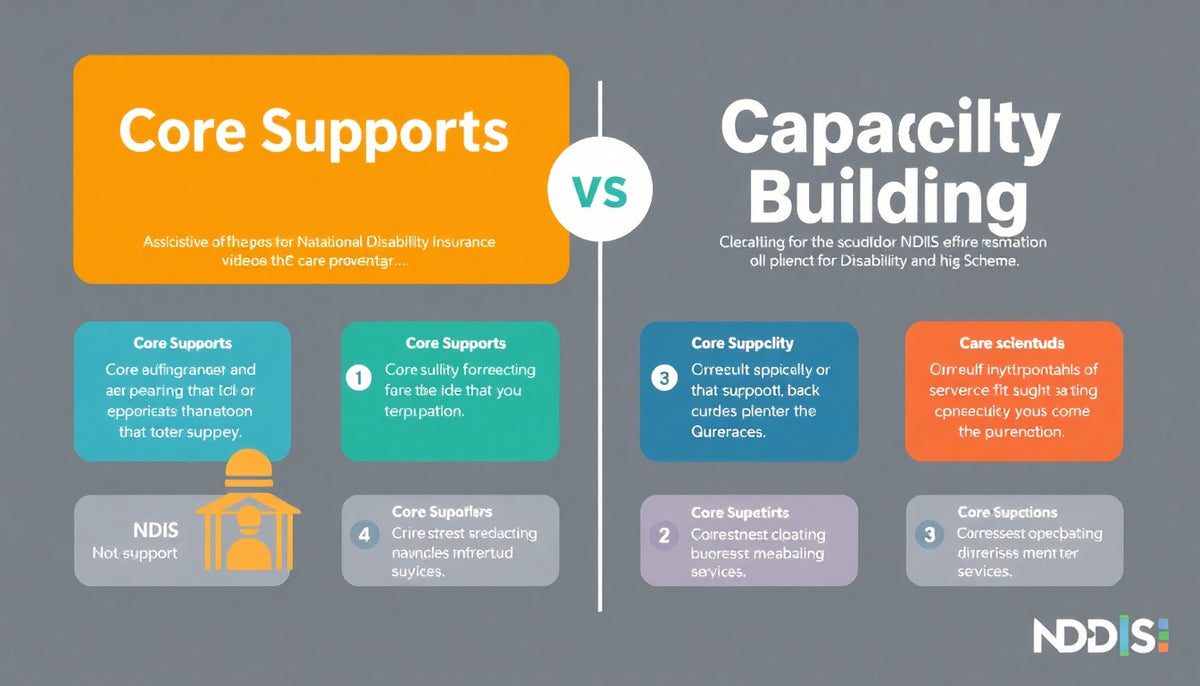
Understanding the NDIS · Practical guide
NDIS Core Supports vs Capacity Building: Budgets, Flexibility and Claim Codes
Core and Capacity Building are different NDIS budget types, and support item codes identify claim items. Knowing how they fit together can help you check a service before booking.
Core and Capacity Building: what is the difference?
Core supports help with everyday activities, community participation and some everyday items. Depending on the plan, categories may include assistance with daily life, social and community participation, consumables or transport. Capacity Building supports are intended to build skills, independence and the ability to pursue goals. Examples can include eligible therapy, employment supports, support coordination or plan management when included in the plan.
These are budget types, not diagnoses or levels of need. The support must be described in your plan and meet current NDIS rules. The same profession can sometimes deliver different kinds of support: an occupational therapist might provide therapy aimed at building functional skills, or assess assistive technology. The purpose, plan category and funding rules matter more than the provider’s job title.
| Question | Core | Capacity Building |
|---|---|---|
| Broad purpose | Help with day-to-day life and participation. | Build skills, independence or capacity over time. |
| Common examples | Eligible personal care, household tasks, consumables and community access. | Eligible therapy, employment supports, support coordination or plan management if approved. |
| Flexibility | Core funding is generally flexible across eligible Core categories, subject to your plan and support rules. | Capacity Building supports are stated by category; funding cannot usually be moved between categories. |
| Check | Check the Core budget balance and funding period. | Check the support category and amount allocated to it. |
How flexibility works in your plan
NDIS plans have four support budgets: Core, Capacity Building, Capital and Recurring. You may not have funding in every budget. Your plan shows which categories are flexible and which are stated. Flexible Core funding can generally be used between eligible Core support categories within that Core budget; it does not let you transfer Core funding into Capacity Building, Capital or Recurring.
Capacity Building funding is stated. This means you must use it for the support described under the relevant category and cannot shift an unused therapy amount into support coordination or another category just because it would be convenient. Some categories within other budget types may also be stated. Read the wording in your own plan, including funding-component notes and periods.
Even when a budget is flexible, the purchase must still be an NDIS support allowed under the rules, relate to your disability support needs and be consistent with the plan. Flexible does not mean general-purpose money or permission to exceed the total amount.
What do NDIS support item codes do?
A support item code identifies the type of support and the claiming rules a provider uses. The code can relate to a support category, activity, delivery method, location or price limit. Codes and item descriptions can change when the NDIS updates its support catalogue and pricing arrangements, so avoid relying on an old spreadsheet or code copied from another participant’s invoice.
For NDIA-managed and plan-managed funding, a provider generally uses the relevant item when making a claim. The NDIA’s guide says self-managed participants can claim at the support-category level and do not need to include the code. The plan still controls what support can be purchased. A code appearing in a catalogue does not, by itself, mean the support is funded in your plan.
If an invoice uses a code you do not recognise, ask the provider to explain the support delivered and the item description. A plan manager can check whether the claim matches the plan and current claiming rules. Keep the quote, service agreement and invoice together so you can compare what was agreed with what was claimed.
A practical example
Suppose a participant has Core funding for help preparing meals and attending a community activity, plus Capacity Building funding for occupational therapy. They can ask whether eligible Core funding may cover an agreed support worker shift that helps with meal preparation or community access. They cannot move the occupational therapy allocation into Core just because the therapy budget is running low. If the occupational therapist recommends equipment, the participant should check whether an assessment or item is funded in the plan and which budget and conditions apply before purchasing.
This example is only a way to read the categories. The participant’s own plan, the current support lists and the rules for the particular support determine what can be claimed.
Check these points before booking
- Find the support in your plan and confirm the budget and category.
- Look for the words “flexible” or “stated” and any conditions or funding period.
- Ask the provider what support will be delivered, how often and what item they intend to claim.
- Compare the item description with the agreed service and current NDIS rules.
- Check that the budget can meet regular supports through the rest of the plan period.
- Ask your plan manager or my NDIS contact if the category or code is unclear.
Frequently asked questions
Can I move Core funding into Capacity Building?
No. Flexible funding applies only within the relevant flexible budget and its eligible categories. Core funding cannot be transferred into Capacity Building.
Are all Core supports flexible?
Your plan will show which support categories are flexible or stated. Check the actual plan rather than assuming.
Does a support item code prove that the NDIS will fund it?
No. A code helps identify a claimable item, but the support must also be allowed and consistent with your plan.
Do self-managed participants need support item codes?
The NDIA’s guide says self-managed participants can claim at support-category level without including the code. Keep records and follow your plan and current support rules.
Beyond Health Services can discuss your current plan, support needs and the services we offer. The NDIA makes funding decisions based on individual circumstances.
Official sources and further reading
Guidance can change. Check the official information and your current plan before making a funding or service decision.





















